BLOG
Stay up to date with news from Essential

All blog articles
- All
- Cloud Infrastructure
- Employee & Partner Experience
- External Access Management
- Learning Management
- Migration
- Modern Workplace Experience
- Performance Management
- Resource Booking
- SharePoint Design
- SharePoint Management
- Teams Management

Introduction Microsoft Teams and SharePoint sites have transformed communication and collaboration in the workplace, helping to drive efficiency, supporting hybrid working, underpinning employee engagement efforts and more. Microsoft Teams in […]

You’ve probably seen examples of room booking systems that use Power Apps to allow selection of available workspaces from a list. For example, you can find one here. Click ‘Create’, […]

Perfect for touch down workspaces, car-parking bays, equipment (e.g., laptops, scanners), and even office fitness classes, pooled resources offer an easy way to share out a limited number of resources. […]

Many enterprises adapting to a hybrid work model are now re-evaluating their office space needs, often with the aim of reducing or reconfiguring it. Getting the information you need in […]

Discover how an LMS that can help you track and manage regular policy and security updates.

Each new page you create in SharePoint – unless you opt for the ‘Plain’ variant – offers the opportunity to use a wide format title image across the top. Finding […]

Recommended Image Sizes in Modern SharePoint Images used within SharePoint can be different sizes and aspect ratios depending on your chosen number of columns and web part layouts. In most […]

I’ve been interested to read about recent incidents where ‘business’ communications on social platforms like WhatsApp, have been deleted. Having been around the block a bit, it reminded me of […]

Where is RSVP – Yes In Person that Microsoft promised a few years ago? Here’s 4 problems not having it is creating for your company.

Where is RSVP – Yes In Person that Microsoft promised a few years ago? Here’s 4 problems not having it is creating for your company.

Many organisations facing SharePoint online ‘overage’ costs are using third-party SharePoint archiving solutions,…but does Microsoft now have it’s own archiving solution?

Introduction SharePoint Online (aka SPO) offers an impressive storage capacity: Each tenant is initially allocated 1TB of storage plus an additional 10GB per licensed user, but is it enough? In […]

Want to upload a bespoke festive Teams background? Here’s how: Next, this is the weird thing you need to do to ‘check out’ and apply your festive Teams background: Did […]

In this blog we will look at how you can use SharePoint Lists to allow individuals to answer a series of quiz questions over a series of days. The starting […]

As part of its advanced security services, Microsoft lets you set up a Simulated Phishing Attack that’s linked with online training. This is a great service that’s part of the […]

In today’s hybrid working environment, hot desking is widely used as an approach to shrinking office space costs.

Effective training is not a one-size-fits-all scenario. Each employee has unique needs, competencies, and career aspirations, and ensuring the relevant courses, learning pathways or certifications are made available is not […]

Training in the fire service is critical for everyone: from fire fighters through to Chief Fire Officers, operational and non-operational staff, and of course, on-call team members, who crew 60 […]

Pre-COVID-19 and hybrid working, the need for a desk numbering system to identify desks was of minimal importance, as individuals would typically sit at the same desk every day. Now, […]

Managing external users in Microsoft 365 is possible, but labour-intensive for IT Teams. Here’s how to simplify and delegate access management.

Using unlicensed or non-on brand imagery on your SharePoint sites can result in copyright and trademark violations – it can also send your marketing team bananas! In this article we’re […]

Discover how an LMS that can help you track and manage regular policy and security updates.

Unlike a petrol or diesel engine that takes just minutes to fill, a typical electric car will take at least half an hour to recharge. Recent reports of Charge Rage […]

Consumer messaging apps like WhatsApp have existed for several years, however their adoption as a business tool went through the roof during the pandemic. Amidst struggles to deliver a remote […]

As your workspace needs evolve, adding or removing numbered desks from your booking system can cause confusion. Here’s some workarounds.

Discover how an LMS that can help you track and manage regular policy and security updates.

Double booked meeting rooms used to be a major headache for building managers, especially in organisations that use Microsoft resource mailboxes to represent rooms. This is because older versions of […]

In this article we will explore whether Microsoft Bookings can be used to sublet your workspaces to an external audience.

When it comes to your corporate intranets, the use of carefully selected and strategically placed images can greatly enhance the user experience and showcase your corporate brand. From our experience […]

Discover the key features of an LMS that can help you track and manage a blend of in-person and online training.

At first glance, it would appear Microsoft 365 (specifically, Exchange online) offers email journaling If you search the internet for ‘Microsoft365 journaling’, you’re likely to find this Microsoft article that […]

Essential is pleased to announce that its learning management system, LMS365, supports the NHS Microsoft shared tenant. What is the NHS Microsoft shared tenant? The NHS Microsoft shared tenant is […]

Is your organisation using Microsoft Teams to support collaboration and remote working? By introducing a learning management system (LMS) that builds on this platform, you can turbo-charge your eLearning initiatives. […]

The modern workplace is evolving rapidly, and businesses are increasingly seeking innovative ways to adapt and thrive in the new normal. One such transformation is the rise of hybrid meetings, […]

Centralised identity management and directory federation services have undoubtedly revolutionised the way organisations communicate and collaborate with each other. However, there are situations where these services are either not appropriate […]

A great visitor management system can provide numerous benefits to businesses that welcome contractors or clients to their workspace. It can streamline the check-in process, reduce wait times, and create […]

Hot desking, also known as desk sharing or flexible seating, is a modern office trend that allows employees to use any available workspace instead of being assigned to a permanent […]

If, as an organisation, you have invested in Microsoft 365, by using an LMS solution that builds on this platform, you can turbo-charge your eLearning initiatives. Whats in this article […]

We are delighted to announce that LMS365, the learning management system (LMS) developed for the Microsoft 365 platform, now works seamlessly with Microsoft Viva Learning. Whats in this article What […]

Training a hybrid workforce in a high security environment poses many challenges….

As remote learning, virtual training and other eLearning technology has become commonplace since Covid-19, so has the use of Learning Management Systems (LMS) to help manage the creation, delivery, and […]

What is an LMS and what does it mean in healthcare? Learning management systems (LMSs) are software platforms designed to streamline the management, delivery and tracking of learning activity. They […]

To be honest, in light of the current home-working situation we thought that managing the booking of meeting rooms and hot desks would be the last thing on the agenda.

What is preboarding? We’re familiar with the term onboarding as being the induction process that starts when an employee joins your company. Preboarding is similar, but it comprises the steps […]

Why might you need to migrate your email journal? The fact that journal records are created for compliance reasons, and are therefore retained for many years, makes the need to […]

Email journaling is a way of recording email communications that is typically deployed by organisations that need to achieve compliance.

In this article we will explore whether Microsoft Bookings can be used to sublet your workspaces to an external audience.

When you have thousands of learners to support, ensuring everyone is presented with the right learning programmes and content for their role is challenging to say the least. Each different […]

We caught up with our migration guru, Dave Kellett, over a cup of tea & biscuit to pick his brains on the challenges folk face when migrating Mimecast email journals […]

If you glanced around the average office, you may wonder whether there was a need to pre-book desks at all. According to recent studies, two thirds of desks remain unused. The […]

How to do contactless room & desk booking signage ‘on the cheap’ Sometimes installing room screens and individual desk devices throughout an office space can not only be cost-prohibitive, the […]

Having a good strategy for identifying meeting rooms in a large organisation can be a challenge – especially when there’s 100’s of different rooms, floors, room sizes, room types, different […]

We are excited to announce a freemium licence of our learning management system for Microsoft 365, LMS365. Our freemium licence offer is a great way for enterprises to experience the […]

EWS (Exchange Web Services) is an API that allows applications to access mailbox items such as email messages, free/busy status, and contacts. It is used by a range of applications that you may have running in your enterprise, an example of which is any desk booking and room booking system that integrates with Microsoft Exchange.
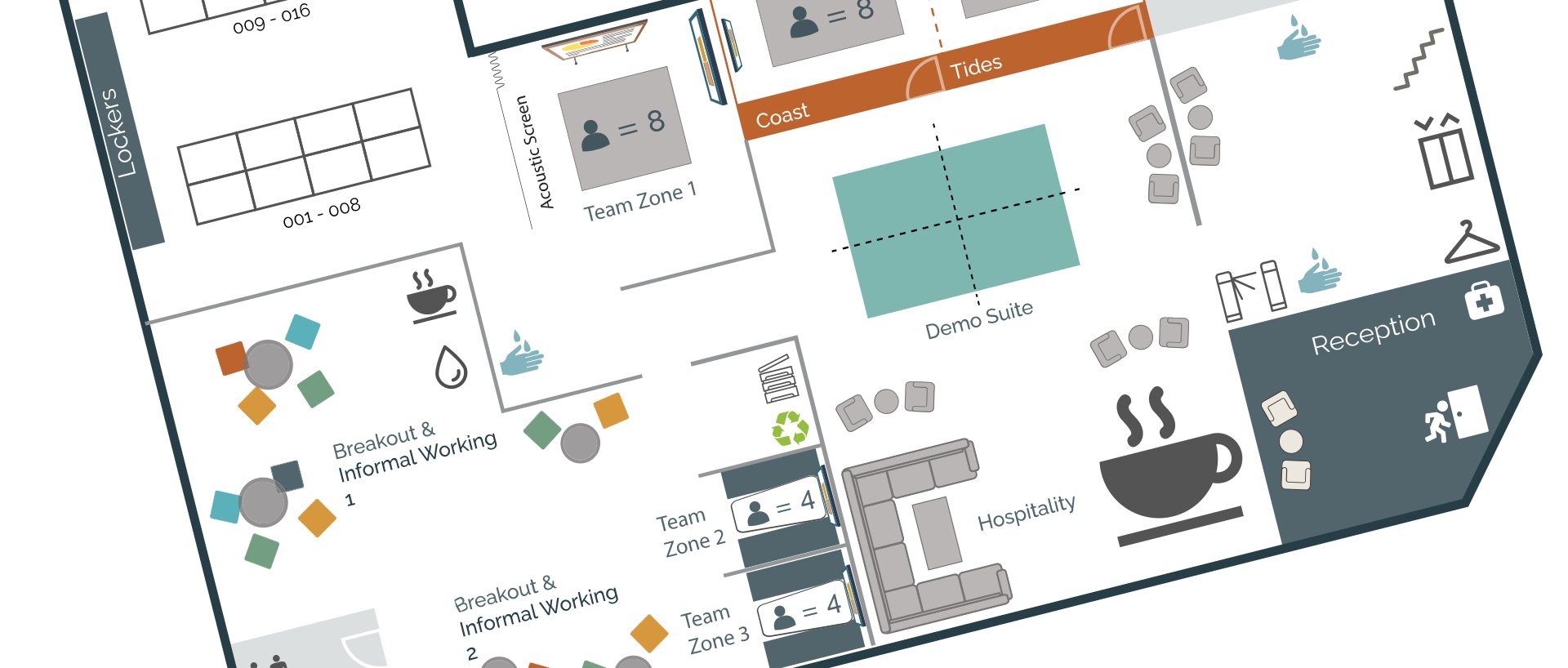
What is an interactive floor plan? Most desk booking systems allow workspaces to be booked directly from an interactive floor plan. Interactive floor plans are graphics that depict your office […]

Advent calendar ideas for your SharePoint intranet Getting your hybrid workforce into the habit of visiting your company intranet – and keeping your SharePoint content up-to-date and vibrant – is […]

Are you preparing to support ‘hybrid meetings’? Here’s what you need to know about booking hybrid meetings in Teams.

During Covid-19, a workspace booking system could help your workforce secure a socially distanced desk when visiting the office. It could also let you track office occupancy (and when) if you needed, to send out an alert and inform the facilities team which desks needed between-use sanitising.

The need to optimise use of your meeting rooms and collaboration spaces has become vital as hybrid workers prioritise face-to-face meetings when they visit the office. This makes meeting room […]
Hot desking is commonly used term to describe a concept where a limited number of available workspaces is shared amongst a workforce that does not need a permanently assigned desk.

In its simplest form, a desk booking system refers to a software tool or platform that enables employees to reserve a desk or workspace for a specific timeframe.

When not having a dedicated desk becomes an attractive proposition Essential started promoting the benefits of desk sharing almost 15 years ago. At this time the prospect of not having […]
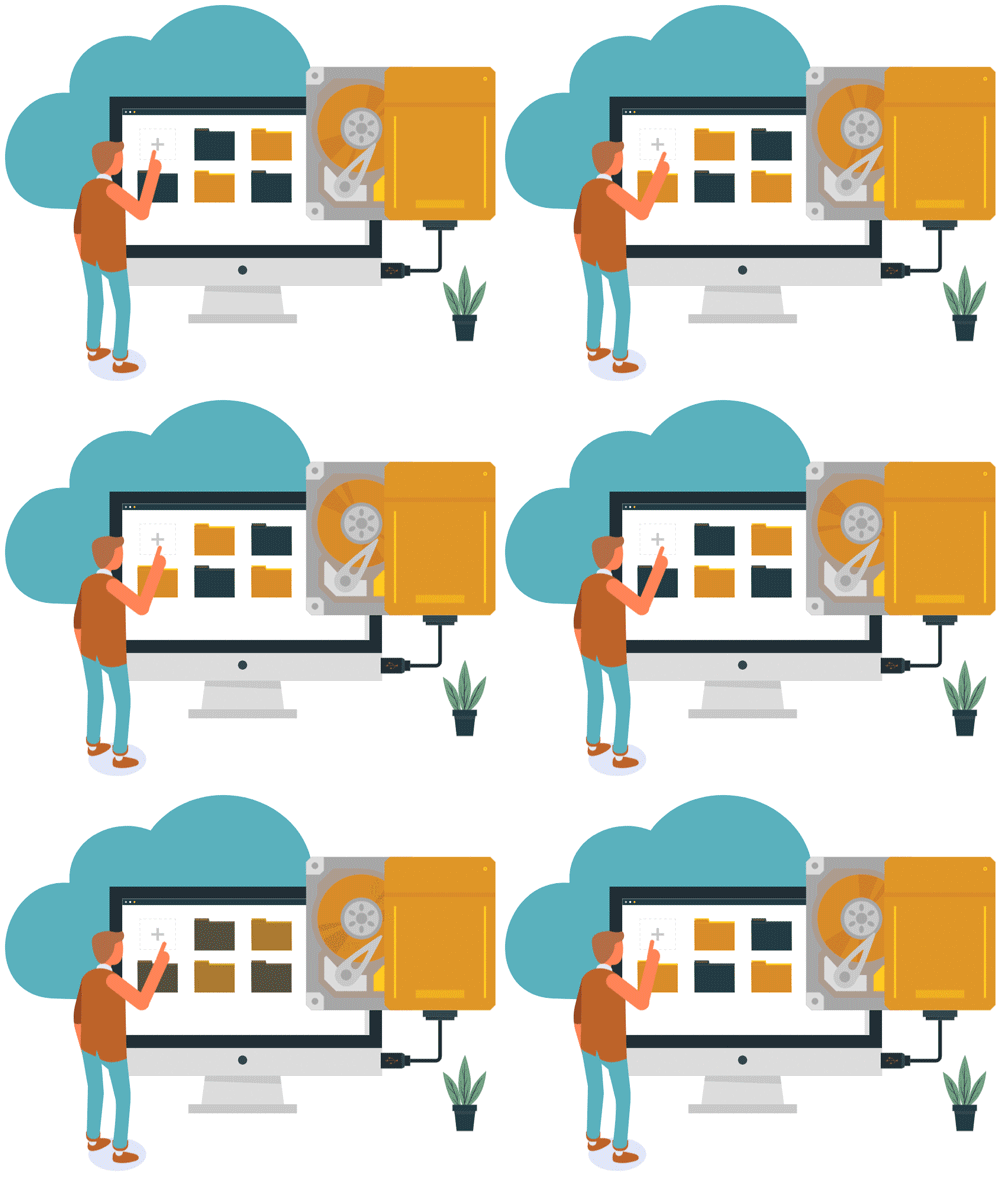
Microsoft’s drive shipping service is multi-step process via which large amounts of PST files can be uploaded into Microsoft cloud. This is how it works…could it work for your migration?

Switching from fixed desks to flexible working spaces is challenging on many levels, here are some hot desking tips you need to know for your workforce Not only do you […]

What are hybrid meetings? As we emerge from the pandemic, the way we work is likely to have changed forever. The term ‘hybrid working’, reflects a now commonplace scenario where […]

Scanning a QR code from your mobile device has become a familiar way to get contactless and convenient access to restaurant menus, registering your visit to a venue using the […]

Microsoft recently announced Viva – an employee experience platform (XP) that pulls together the threads of a number of existing applications including Teams, SharePoint, Yammer, AI, Workplace Analytics, etc. to […]

What is email journaling? Email journaling is where a copy of all email traffic sent and received by an organisation (and optionally, within an organisation) is written to a separate, […]

How you can make returning to the office work for everyone The signs are encouraging, and although social distancing rules have relaxed, June 21st is still the date most firms […]

FACT: If you migrate legacy shortcuts into Exchange Online, it’s highly likely they’ll ‘still work’ if your archive remains on-premises. So do you need to get rid of it?

As Covid-19-related restrictions are slowly easing around the world, many businesses are preparing to return to the workplace.

Introduction to public folders in Microsoft 365 Introduced into Microsoft Exchange over 25 years ago, public folders are shared folders that can be accessed by multiple users in an organisation. […]


Are you, like many organisations, looking at how you can replace your previously ‘in person’ training with an on-line service? The technology we have available in platforms such as Zoom […]

The mute story so far As a Teams meeting participant, the mute button has proved to be a pretty useful feature during lockdown to mask out the various screaming baby/dog […]

Setting up the concept of bookable desks – otherwise known as ‘hot desking’ – is more than just a case of designating desks and making them ‘bookable’.

Microsoft has announced that they will be changing the way that applications can authenticate with Office 365 Exchange Online.

Implementing a resource-booking solution for parking is a great way to maximise the use of an increasingly scarce (and costly) resource, but it takes exceptionally careful planning to navigate all the potential complications.

Making the necessary changes that enable workforces to adapt to a shrinking office space – especially where that means adopting ‘non-territorial working’ – requires a multi-discipline strategy involving people, design […]

There’s no doubt that Microsoft Outlook Calendar makes a logical place for staff to book resources such as meeting rooms. Apart from being convenient for end users, behind the scenes, […]

With the GDPR and other industry-specific regulations in full force, it’s not a good idea to take it on faith that your employees are up to date on their compliance […]

When our customer wanted to give staff a quick and easy way to authenticate on-screen meeting room bookings and check-ins for its Microsoft Exchange-integrated room and desk booking system, the […]

For those of us who’ve spent half our lives behind a dedicated desk, or in a private office, having a workplace with no seating assignments (and fewer workstations than employees) […]

Prior to Microsoft 365, enterprises were fully responsible for providing their own business continuity and data protection. A multi-pronged, belt and braces approach for backup, that included the following elements, […]

Along with PSTs, Public Folders are usually the last data repository to be dismantled when you’re migrating to Office 365. They’re typically big and full of static content, much of […]

Are you being locked in by your cloud vendor? Whenever I get on a flight I always count the number of rows to the nearest exit, so I can grope […]

Productive meetings have been a hot subject since that Elon Musk leaked email. But why did Elon chose to target meetings in order to increase company output? Did you know that […]

If migrating user mailboxes in a hybrid environment wasn’t challenging enough, migrating email archives to Office 365 can introduce all sorts of complexity you hadn’t bargained for. Here’s 5 […]

During WW2, a group of people found themselves trapped within occupied France: prevented from having a voice, suppressed from independent thought and at risk of capture, persecution – even death. […]

Free retention of ex-employee’s data At present, if you want to retain the mailbox contents of former employees’ mailboxes there’s a facility called ‘Inactive Mailboxes’ that you can use. The […]

First you needed an archive to give Exchange some ‘breathing room’. Native Exchange just wasn’t up to the job of holding so much email, especially if you wanted to switch […]
The need to optimise use of your meeting rooms and collaboration spaces has become vital as hybrid workers prioritise face-to-face meetings when they visit the office. This makes meeting room […]

Why are BCC’d recipients so important? In relation to email, BCC stands for “blind carbon copy.” Just like CC, BCC is a way of sending copies of an email to […]

There’s two things to bear in mind when it comes to migrating mailbox permissions to Office 365: Number 1 – You won’t get an ‘easy ride’ The process of switching […]
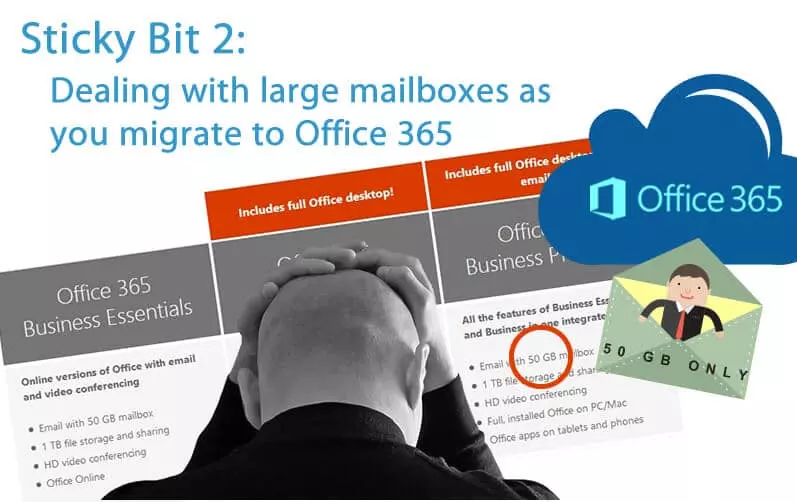
Apart from ensuring you meet the terms of your Microsoft 365 licence plan, understanding your overall mailbox sizes – as well as the size of any archives you want to […]

So what’s the problem? When you log on to Office 365 you’re functioning in the ‘big wide world’, and Microsoft wants to know who you are. This means that logon […]

STOP PRESS: COVID-19 means that contactless operation for your room booking service across all functionality outlined in this article is now VITAL. It’s an all-too-common problem: You try to book a […]

The ability to automatically update Active Directory from data held on its HR systems proved vital for this mining company in terms of improving its customer services. Whenever staff transferred […]

Although an archive might be something the IT department would prefer to put on a tape and forget about, most email archives need to be ‘kept alive and kicking’ over […]

This is a very frequently asked question for anyone wanting to switch to Microsoft’s cloud. The short answer is: If you’ve chosen the right software for your migration project, your […]

When going through an email archive migration, understanding the way your end-users work with their archives is worth getting to grips with, otherwise you could be heading for a bumpy […]

Veterans of over 100 archive migration projects to date, Essential Computing is one of TransVault’s longest-standing partners… Since its inception in the early 90s, Essential has been at the cutting-edge […]

Warning: .psts are like vermin. Experts agree they are a pest and IT departments across the world are all too familiar with the support nightmares they create. They also carry […]
Whether your email archive is on-premises or in the cloud, here’s just 5 sound pieces of advice from the Essential archiving team on what IT departments should not do when […]
There’s been a lot of blog posts flying around recently around the growing trend towards ‘Bring your own device’ (BYOD). Deloitte and Citrix are some of the big names to announce […]

Even though Microsoft offers free tools to import your PST files into Microsoft 365, does anyone really relish the thought of migrating ALL of their PST files into Exchange? Probably […]

We read with interest a Mimecast blog which refers to a TechCrunch article on the News Corporation phone hacking scandal. The archiving vendor alludes to the concept of an email archive making it possible to permanently […]

Wow – this item was posted over a decade ago, but it’s still relevant if you’re replacing ‘on-premises’ systems and storage… It’s always a good idea to be diligent in […]
We’re currently involved in a number of different archive migration projects, helping customers to move legacy email information from one system to another. These are often challenging projects to manage, […]

We’ve all done it; composed an email, hit send, then regretted it. The heart-rate goes up and we become people of action, trying in vain to recall it. Invariably it’s […]

This article, recently signposted to me by my good friend and long-term business acquaintance, Richard Marshall, talks about the MIME standard and the two guys that devised it: Ned Freed […]

Mindful of the fact that sending an email to a colleague can sometimes be a poor substitute for a telephone conversation or a face-to-face meeting, RCT Homes has introduced the […]

Prompted by the press that surrounded the email audit trails at News International, Computing magazine interviewed Essential for its views on the importance of strong email and data governance in […]
Our archive migration service is taking off and we are getting a reputation for being the ‘Pickfords’ Removals’ of the email archive world. Each new project brings its own set […]